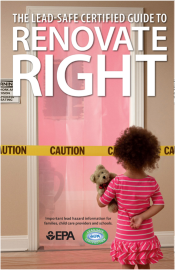
We talk about the Renovate Right pamphlet in every EPA RRP class. You have to hand it out. You have to get it signed. You have to keep the record for three years. What we do not always have time to do in class is walk through what is actually printed inside it. So here is the pamphlet, front to back, in plain language, and the links to download it straight from the EPA.
The Basics
The full title is Renovate Right: Important Lead Hazard Information for Families, Child Care Providers and Schools. It is published by the EPA (document number EPA-740-K-10-001), the current version is the September 2011 revision, and it is free. It comes in English and Spanish, in color or black and white, and as a booklet layout or a portrait layout you can print on a normal office printer.
It is written for three audiences: people who live in a home built before 1978, people who own or run a child care facility, preschool, or kindergarten classroom built before 1978, and parents of kids under six who attend one of those facilities. It is not written for contractors, and the pamphlet says so up front. It also says it is not a guide for abatement work and not a complete guide for do-it-yourselfers.
Why the Law Says You Have to Hand It Out
The opening pages explain the rule from the customer’s side. Federal law says any contractor who disturbs painted surfaces in a home, child care facility, or school built before 1978 has to be certified and has to follow specific work practices. It tells the customer to ask to see your certification.
It also tells them when they are entitled to the pamphlet: any time a contractor is going to disturb more than six square feet of painted surface in a room on the interior, more than twenty square feet on the exterior, or replace windows or do demolition in a pre-1978 property. If you have taken our class, you know those numbers. Now your customer knows them too.
The Facts About Lead
The pamphlet gives the customer the same foundation we give you in Module 1. Lead-based paint was used in more than 38 million homes before it was banned for residential use in 1978. Lead damages a child’s brain and nervous system and shows up as lowered IQ, learning disabilities, and behavior problems. A kid can look perfectly healthy and still have a dangerous level of lead in his body. Adults are not immune either. Low-level exposure is tied to high blood pressure, and a pregnant woman who is exposed passes lead to the baby.
The route of exposure is dust. Deteriorating paint and contaminated soil tracked in from outside create dust you cannot see, and normal hand-to-mouth activity, especially in little kids, moves it from the floor and window sills into the body. Sanding, scraping, burning, brushing, and blasting lead paint put that dust and fumes in the air.
The pamphlet tells families that a blood test is the only way to know if a child has been poisoned, that the local health department can help, and that the daily defenses are simple: clean floors and window sills regularly, wash kids’ hands, bottles, pacifiers, and toys often, feed them a healthy diet, and wipe your feet before you come inside.
Checking the Home for Lead
The customer gets three options, and they are the same three we teach. They can assume lead is present and have you work lead-safe. They can hire a certified inspector or risk assessor to find out where the lead is and whether there are hazards from paint, dust, or soil. Or you, the certified renovator, can test the surfaces you are going to disturb with an EPA-recognized test kit or a paint chip sample sent to an EPA-recognized lab.
What the Pamphlet Tells Property Owners to Expect From You
This is the section you want to read closely, because it is a list of things your customer has been told to ask you for.
Verify the contractor is certified at epa.gov/getleadsafe or by calling 1-800-424-LEAD. Ask to see a copy of the firm certification. Ask whether the contractor has been trained in lead-safe work practices and ask for a copy of the training certificate. Ask how the job will be set up and performed lead-safe. Ask for references from at least three recent jobs in pre-1978 homes, and actually call them.
Then it tells them what to put in the contract: which parts of the home are the work area, which lead-safe practices will be used there, that dust and debris will be confined to the work area, and that the contractor will clean the work area, verify it was cleaned adequately, and re-clean if it was not. It tells them to share any prior lead test results with you.
And it tells them what to do if they think you are cutting corners: tell you to comply, call the local health or building department, or call 1-800-424-LEAD. If the property gets HUD assistance, the pamphlet notes that HUD’s Lead Safe Housing Rule applies on top of all of this.
Tenants and parents of kids in a child care facility get a shorter version of the same page, with the added instruction to contact the landlord if something looks wrong.
Preparing for the Renovation
The pamphlet walks the family through what living with your containment is going to look like. The work area will be off limits, possibly sealed in plastic, until the job is finished and cleaned. They may need alternate arrangements for a bedroom, bathroom, or kitchen if that is where you are working. They need a safe place for pets, because pets get poisoned too and track dust around the house. They should plan a separate path for your crew to get in and out that does not go through the family entrance. Furniture and belongings come out of the work area, and what cannot be moved gets wrapped. The forced-air heating and cooling gets shut off during the work so dust does not travel through the ducts. And if all of that sounds like too much, they can move out temporarily. Child care facilities are told to think about where the kids will go.
If you have ever had a customer surprised by your setup, this is the page that should have prepared them.
During the Work: The Three Things You Have to Do
The pamphlet boils lead-safe work down to three practices and describes each one for the customer.
Contain the work area. Warning signs go up. Plastic and tape cover floors and furniture that cannot be moved and seal doors and vents. On the exterior, the ground gets covered and in some cases vertical containment goes up.
Avoid methods that make a lot of dust. The pamphlet names the prohibited practices for them: open-flame burning or torching, power sanding, grinding, planing, needle gunning, or blasting without a shroud and HEPA vacuum attachment, and heat guns above 1,100 degrees Fahrenheit. It also describes what good looks like: misting with water before sanding or scraping, scoring paint before separating components, and prying and pulling components apart instead of breaking them.
Clean up thoroughly. Clean daily. When the work is done, HEPA vacuum every surface, then wet wipe and wet mop with plenty of rinse water, all before the plastic comes down. If there is any dust, paint chips, or debris left, clean again.
After the Work Is Done
The pamphlet explains cleaning verification to the customer: the contractor wipes the floor and other surfaces with disposable cleaning cloths and compares them to an EPA cleaning verification card. It states that EPA research shows lead-safe work practices plus that verification effectively reduce lead dust hazards.
It also tells the customer that lead-dust wipe testing by a lab is available if they want it, that the EPA does not require you to do it, and that if they want it they should write it into the contract before the job starts, including who will do the sampling and whether re-cleaning will be required based on the results. That is worth knowing before a customer brings it up at the end of the job instead of the beginning.
Resources and Contacts
The back half of the pamphlet is a resource list: the National Lead Information Center at 1-800-424-LEAD (5323), the contact information for all ten EPA regional lead offices, and the lead programs at the Consumer Product Safety Commission, the CDC, and HUD’s Office of Healthy Homes and Lead Hazard Control. It also points to the other EPA publications, including Steps to Lead Safe Renovation, Repair and Painting and Protect Your Family from Lead in Your Home.
The Form on the Last Page
The last page is the one that matters most to you. It is the sample pre-renovation form, and it is your proof.
The top section is the occupant’s confirmation of receipt: a statement that they received the pamphlet before the work began, with a printed name, signature, and date.
The bottom section is the renovator’s self-certification for tenant-occupied units, and it covers the two situations we talk about in class. If the tenant refused to sign, you check the box certifying that you made a good-faith effort to deliver it, the occupant declined to sign, and you left a copy with them. If the tenant was not home, you check the box certifying that you made a good-faith effort, the occupant was unavailable, and you left a copy at the unit by sliding it under the door or however else you left it. Then your name, the date you attempted delivery, your signature, and the unit address.
The form also reminds you of the mailing option: mail the pamphlet at least seven days before the job and keep the post office certificate of mailing.
Fill this page out, get it signed, and put it in the job file with everything else. Keep it three years.
Where to Download It
Get it directly from the EPA. Do not pay anybody for it.
- The EPA’s Renovate Right page, with every version
- English, color, portrait (prints on a regular printer)
- English, black and white, portrait
- English, color, booklet (for double-sided folded printing)
- Spanish (Guía para remodelar correctamente), color, portrait
One note. If you still have a stack of the older April 2010 pamphlets, the EPA published a one-page insert that replaces page 10 of that version. It is on the same EPA page. The cleanest fix is to recycle the old ones and print the September 2011 revision.
Why This Matters to You
Your customer is going to read this pamphlet, or at least skim it. It tells them what to ask you for, what your setup should look like, what practices are off limits, and what a clean job looks like when you leave. If your work matches the pamphlet, you look like the professional they were told to hire. If it does not, you handed them the checklist to prove it.
Print a stack. Keep them in the truck. Hand one out before every job. And if it has been a while since your class, or you have new guys who have never seen the form on the back, come see us. We run EPA RRP Initial and Refresher classes in more than thirty states.

