
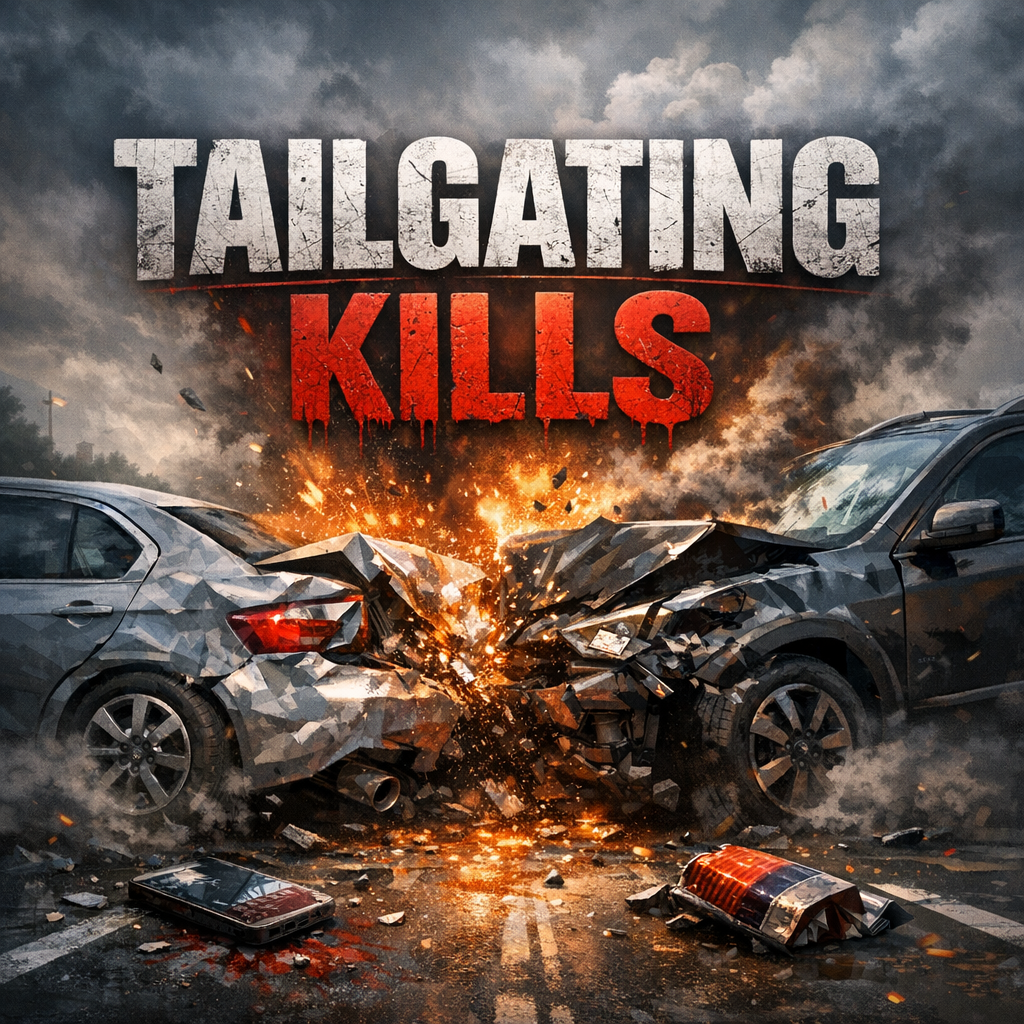
The most expensive few feet on the highway may be the ones you refuse to leave open.
You do not need room to stop for your mistake. You need room to stop for someone else’s.
If You Drive, You Know the Person
You are moving with traffic. You are doing the speed limit – maybe a little more – and there it is in your mirror: a car sitting so close to your bumper that you can barely see its headlights.
For what? To arrive 12 seconds earlier? To make you move? To prove a point? Whatever the reason, tailgating is one of the strangest risks we routinely accept on the road because the driver taking the risk gains almost nothing from it.
Federal traffic-safety data consistently identify speeding, alcohol impairment, distraction, and failure to use restraints among the major contributors to roadway deaths. Following too closely does not appear as a neat, standalone national fatality category in the same way. That does not make it harmless. It means we should be careful about pretending there is one simple national number that captures every crash in which inadequate following distance played a role.
Tailgating Is a Risk Multiplier
The biggest problem with tailgating is that it takes an ordinary driving mistake and removes the time and distance you need to recover from it.
The driver ahead of you does not have to be a bad driver. A deer can enter the road. Traffic can stop suddenly. A tire can blow. A box can fall from a truck. A child can run into the street. The driver ahead may simply see a hazard that you cannot see yet.
You do not need following distance only for your mistake. You need it for somebody else’s.
Selected 2023 U.S. Roadway Fatality Factors
These categories overlap and should not be added together. They provide context for major traffic-safety problems; they are not a ranked list of mutually exclusive crash causes.
| Factor | Fatalities |
|---|---|
| Alcohol-impaired driving | 12,429 |
| Speeding | 11,775 |
| Unrestrained occupants | 10,484 |
| Motorcyclists | 6,335 |
| Distracted driving | 3,275 |
The Physics Do Not Care How Good a Driver You Think You Are
At 70 mph, a vehicle travels about 103 feet every second. At 80 mph, it travels about 117 feet every second. That distance disappears before braking distance is even considered.
If your perception-and-reaction process takes roughly 1.5 seconds, a car traveling 70 mph covers about 154 feet before the braking phase is fully underway. That is more than ten typical car lengths traveled during reaction time alone.
This is why following distance is better thought of in seconds rather than feet. A time gap grows naturally as your speed increases. A three-second gap at 70 mph is roughly 308 feet. In rain, darkness, poor visibility, heavy traffic, or other adverse conditions, give yourself more.
How Far You Travel in One Second
| Speed | Feet per second | Distance in 3 seconds |
|---|---|---|
| 35 mph | 51 ft | 153 ft |
| 55 mph | 81 ft | 243 ft |
| 70 mph | 103 ft | 309 ft |
| 80 mph | 117 ft | 351 ft |
The $0 Safety Device Already Installed on Every Car
Your car may have automatic emergency braking, collision warnings, cameras, radar, airbags, and a dozen other safety systems. But one of the most effective defensive-driving tools costs exactly zero dollars: empty pavement.
Following distance gives you time to see, time to think, time to brake, and sometimes time to choose an escape route instead of simply hitting whatever is in front of you.
You do not have to buy it. You do not have to maintain it. You just have to stop giving it away.
The Tailgater’s Illusion
Tailgating feels faster because you are physically closer to the vehicle ahead. But if both vehicles are traveling at the same speed, being 20 feet behind instead of 300 feet behind does not meaningfully change your arrival time.
Imagine two drivers traveling 70 mph for 10 miles. Driver A leaves a comfortable following gap. Driver B rides the bumper of the car ahead. Assuming neither can actually travel faster than traffic, both cover those 10 miles in about 8 minutes and 34 seconds. The tailgater accepts dramatically less reaction room for essentially no time advantage.
That is the bargain: more stress, less visibility, less reaction time, greater crash risk – and almost nothing in return.
Why Don’t We Talk About Tailgating More?
Speeding is easy to understand and comparatively easy to measure. Police can measure vehicle speed with radar or lidar and write a citation around an objective number. Following distance is more situational: speed, road conditions, traffic flow, vehicle type, visibility, and the duration of the behavior all matter.
It is reasonable to ask whether our enforcement and public messaging give enough attention to following distance. But we should not claim that police ignore tailgating or that it causes a specific number of deaths without evidence to support those claims. The stronger point is simpler: inadequate following distance removes the safety margin that helps drivers survive the unexpected.
Try the Seven-Day No-Tailgating Challenge
For the next seven days, deliberately refuse to tailgate anyone.
Pick a fixed object the vehicle ahead passes – a sign, shadow, bridge joint, or pavement marking – and count: one thousand one, one thousand two, one thousand three. If you reach the object before three seconds have passed, create more room. Add additional time when conditions are poor.
Then pay attention to something else: how much later do you actually arrive? My guess is that you will barely notice a difference. What you may notice is that driving feels calmer because you are no longer constantly reacting to the bumper directly in front of you.
For the Love of God – Back Off
We spend enormous amounts of money engineering safer vehicles, safer roads, better brakes, better tires, better airbags, and smarter collision-avoidance systems. Then some of us throw away one of our biggest safety margins by driving six feet behind another vehicle at highway speed.
Leave the space. Let somebody merge. If someone cuts into your gap, rebuild it. If the driver ahead is going slower than you would like, pass when it is legal and safe. Do not use a 4,000-pound vehicle to express irritation.
Following distance costs nothing. It takes almost no additional travel time. And when something unexpected happens, those few seconds may be the most valuable thing you have.
For the love of God, will you people please quit tailgating?
Sources & Notes
- NHTSA, Traffic Safety Facts 2023 / 2023 fatality data: 40,901 total U.S. traffic fatalities; 12,429 alcohol-impaired-driving fatalities; 11,775 speeding-related fatalities; 3,275 distraction-affected fatalities.
- NHTSA, Motorcycles: 6,335 motorcyclists killed in 2023.
- Unrestrained-occupant figure (10,484) is a restraint-use category and overlaps other crash factors.
- Speed-to-distance calculations use 1 mph = 1.4667 feet per second. The 1.5-second perception/reaction example is illustrative; actual human response and total stopping distance vary with driver, vehicle, roadway, tires, weather, visibility, and other conditions.
- This article intentionally does not assign a national annual fatality count to tailgating because following-too-closely is not presented by NHTSA as a clean, standalone fatality category comparable to speeding or alcohol impairment.

