
When I teach Module 1 of the EPA RRP class, the health effects module, I start with the people who worry me the most: kids. Everything else in the class, the plastic, the signs, the HEPA vacuum, the cleaning verification card, the paperwork, comes back to one question. How do we keep lead out of a child’s body? If you understand this module, the rest of the rule makes sense. If you skip it, the rest of the rule looks like a pile of regulations somebody dreamed up to slow you down.
So let me walk you through it the way I do in class.
First, What Lead-Based Paint Actually Is
The federal definition of lead-based paint is any paint or surface coating with lead equal to or greater than one milligram per square centimeter, or more than 0.5 percent by weight. Remember the 0.5 percent. On the test they will try to throw you off with 5 percent.
Lead was added to paint for color and durability, and it is still used today on ships, aircraft, bridges, and steel. In 1978 the Consumer Product Safety Commission banned it for residential use. That does not mean it disappeared in 1978. Existing stock stayed on the shelves, and a lot of painting contractors loaded up on it as it was being phased out. I asked a World War II veteran in one of my classes what that was like, and he told me where he was from you could buy it for pennies on the dollar. The rule only requires you to account for lead in housing built before 1978, but for your own health and your customers’ health, I would keep an eye out for it through about 1985.
Here is the part that should bother you. Doctors figured out lead paint was poisoning children more than 100 years ago. Most of the industrialized world had it out of their paint by 1928. In this country, the paint manufacturers fought a ban for about 80 years and marketed the stuff directly to kids while they did it. There were coloring books teaching children how to mix lead paint and paint their toys and their beds with it. That is the toxic legacy we are dealing with, and it is sitting in about 34 million homes.
Why Kids Are Different
Children under six are the most at risk, and it comes down to two things: how they move through a house and how their bodies handle lead.
Over time, paint deteriorates on its own. More likely, a homeowner or a contractor disturbs it. That releases lead dust so small you cannot see it, yet you can breathe it or swallow it. It settles on the floors, the tabletops, the window sills, and the toys. A toddler crawls across that floor. He grabs the window sill to pull himself up. He puts his hands and fingers in his mouth, because that is what toddlers do. Nobody had to eat a paint chip. That is how kids get poisoned, and the route of entry is ingestion.
Now the body part. Kids absorb a much greater percentage of the lead they take in. About 50 percent of what a child ingests or breathes stays in the body. As adults, we process out about 90 percent, so roughly 10 percent sticks around. It is poisonous for both of us. For kids it is far worse, and it stores in their bones and can harm them for the rest of their lives.
There Is No Safe Level
This is probably the single most important fact about childhood lead exposure: no safe blood lead level in children has been identified.
CDC’s current blood lead reference value is 3.5 micrograms per deciliter. That number is not a line with safe kids on one side and poisoned kids on the other. It is the level CDC uses to flag children whose blood lead is higher than most kids in the country so they get follow-up and something gets done about the source. As the science has improved, that number has only ever moved in one direction: down. It was 10, then 5, and since 2021 it has been 3.5.
So the goal is not to keep a kid under a number. The goal is to keep the exposure from happening in the first place.
What Lead Does to a Child
In children, lead can cause decreased intelligence, attention deficit disorder, learning disabilities, behavioral problems, nervous system and kidney damage, and speech and language problems. Low-level exposure is the most common, but high levels can cause seizures, unconsciousness, and death.
Study after study says the same thing: once lead damages a child, the damage is permanent. You can remove the child from the exposure, but the damage stays. Kids who were poisoned are seven times more likely to drop out of high school.
Think about what that means in a real kid’s life. No parent gets a notice that today’s exposure knocked a few points off their child’s IQ. What they get, years later, is a kid who has a harder time reading, cannot sit still in class, and struggles in school. And nobody looking at that child is going to trace it back to the dust from a window replacement when he was two. The dust we create today does its damage long after the truck has left the driveway.
You Cannot See It, and That Is the Problem
Lead is different from almost every other hazard on a job site. If a guy falls off a roof, everybody knows there was an accident. If somebody gets cut or burned or hit by something, the injury is right there. Lead is silent. A child does not get visibly sick the day he is exposed. He looks healthy while the lead is going to work on his brain.
That cuts both ways for adults too. The symptoms of lead poisoning, headache, stomach ache, irritability, fatigue, loss of appetite, joint and muscle pain, look like a dozen other things that ail us. And not every medical professional is trained on heavy metals. So when you go to the doctor, for anything, tell them your work history. Working in older houses, you have potential exposure to lead, asbestos, mercury, and silica, on top of every chemical you handle. If they do not know that, they can misdiagnose you, and a misdiagnosis delays treatment and raises the odds of permanent damage.
What It Does to You
Adults usually get poisoned through inhalation. We are the ones cutting, grinding, sawing, and sanding, and if we are not wearing proper respiratory protection or working wet, we breathe it and swallow it. In adults, lead can cause high blood pressure, fertility problems in both men and women, digestive problems, nerve disorders, memory and concentration problems, muscle and joint pain, loss of sex drive, and fatigue. Doctors can get the lead out of your system. What they are not sure of is whether that reverses the damage already done.
And this is the one thing I tell people to take home if they take nothing else. In a pregnant woman, lead in the blood crosses to the baby, and the harm to the baby can include brain damage and death. If you know a couple trying to start a family, and they live in an older house or she grew up in one, it is a solid idea for her to get a blood lead level test before she conceives. If there is lead in her system, hopefully they can deal with it before she is pregnant.
If a doctor thinks you have been poisoned, they will run a blood lead level test. Understand what it tells you: it measures the lead circulating in your blood right now. It says something about recent exposure. It does not measure the total lead stored in your body and it does not predict long-term damage. For adults on the job, OSHA sets the acceptable blood lead and airborne exposure limits.
A Little Dust Goes a Long Way
Renovation that disturbs lead-based paint creates dust and debris, and the debris becomes dust. Tiny amounts are extremely harmful, especially over time, and that dust does not stay where you made it.
In class I dump out a Sweet’N Low packet on the floor, about one gram, and I have everybody walk through it on the way back to their seats. By the end of the day it is gone, tracked all over the room. If that were lead-based paint dust, one gram is enough to contaminate about 3,000 square feet.
You do not just poison your customer. You bring it home. Think about the old dusty work truck where you sit down and the dust pops up off the seat. That is what happens with lead dust on your clothes. It falls off you onto the seat, and every time somebody sits down it comes back up, and everybody in the truck is breathing it. That is why we get ourselves clean every time we leave the work area, not just at the end of the day. Kids swallow the dust during ordinary play. Adults breathe and swallow it during ordinary work. And it is very easy to bring home.
What “Clean” Actually Means
EPA and HUD use dust standards when a clearance is performed: 10 micrograms per square foot on floors, 10 on interior window sills, and 100 in window troughs. What does that mean in the real world? An inspector tapes a twelve-inch square on your floor, wipes it three times, and sends the wipe to the lab or shoots it with an XRF. Nine micrograms, you pass. Eleven, you fail.
Notice that even at nine you left lead behind. There is nothing we can do to make an old house lead-safe. All we can do is work in a lead-safe manner, find the areas that are in distress, leave them better than we found them, and not spread the dust in the process. EPA ran 100 jobs through their testing center in Kansas City using the cleaning verification card procedure we teach in class, and all 100 beat those numbers. The procedure works if you actually do it.
What the Numbers Look Like Across the Country
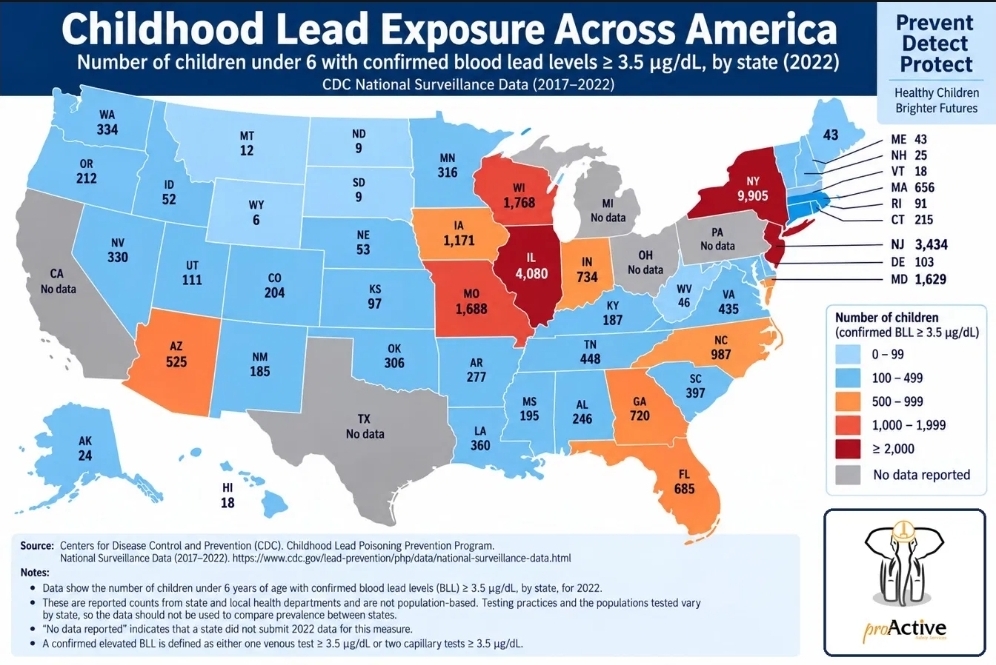
CDC’s national surveillance table currently runs through 2022, the first year the data was categorized using the 3.5 reference value. Among the states that reported, thousands of children under six had confirmed blood lead levels at or above 3.5. New York reported 9,905. Illinois, 4,080. New Jersey, 3,434. Wisconsin, 1,768. Missouri, 1,688. Maryland, 1,629. Iowa, 1,171. North Carolina, 987. Georgia, 720. Kansas, 688. Florida, 685. Oklahoma, 647. South Carolina, 613. Alabama, 567. Tennessee, 534. Nebraska, 517. Washington, 490.
Read those numbers carefully. They are counts of children who were tested and confirmed, not estimates of how many kids were actually exposed. CDC says flat out that this data is not population-based and should not be used to compare states, because who gets tested, how many get tested, and how completely it gets reported are all different from one state to the next. Several states, including Ohio, Michigan, Pennsylvania, Texas, and California, had no 2022 data in the national table at all. “No data reported” does not mean “no lead poisoning.” It means nobody sent CDC a number.
Which brings you back to the lesson of this module. You cannot rely on symptoms to find childhood lead exposure, and a kid who never gets tested never shows up in a count. The numbers on the map are not the whole story. They are proof that this is still happening, in every part of the country, right now.
Two People I Want You to Hear From
I show two videos in class. One is Kevin Sheehan, a contractor who poisoned his entire family working on older houses. It changed how he works. He cannot bid a job in an old house now without pricing in lead precautions, so he does not bring it home to his family and so the people living in the house do not go through what his family went through. He boils it down to three things. Do not make a mess. If you have to make a mess, make it in as small an area as possible. And when you make a mess, clean it up completely. Not broom clean. Not shop-vac clean. Clean like you took your car in to get detailed.
The other is Marcie Jackson, a mother whose daughter was lead poisoned. She describes holding her little girl’s head while nurses held her down for chelation shots, two a day for three to five days, and then finding out lead poisoning is entirely preventable. She lives with not knowing how much of her daughter’s struggles are her daughter and how much are the lead. Her message to contractors is simple: there is a child here and this is old paint. Think for one minute before you start.
This Is Why the Rule Exists
People look at the RRP Rule and see plastic sheeting, warning signs, HEPA vacuums, cleaning procedures, and paperwork. What all of that is actually trying to do is keep lead out of a child’s body. Containment is not just plastic. Cleaning is not making the room look nice. A room can look spotless and still be covered in lead dust you cannot see, and a level of contamination that means nothing to a grown man standing up means something entirely different to a toddler crawling around on the floor.
Testing matters, because it finds exposure and gets families and doctors and the health department involved. But a blood test tells you what already got into the child. Lead-safe work practices are there to keep it from getting in at all. That is primary prevention: control the hazard before the child is exposed.
Renovators work inside people’s homes. We disturb materials. We create dust. In older housing, some of that dust has lead in it. Whether that contamination stays controlled or gets spread through the whole house is decided by the person holding the tools. I do not want anybody leaving my class knowing just enough to pass the test. I want them to understand why the rules are there, because somewhere on the other side of that plastic there might be a four-year-old who has no idea what lead is, and he is counting on the adults doing the work to know.
Do not wait for a poisoned kid to prove there was a hazard. Control it before he is exposed. Lead poisoning is hard to spot, the damage is permanent, kids are the most at risk, and it is completely preventable. That is the whole module.
Data note: State figures come from CDC’s Childhood Blood Lead Surveillance national data table (2017–2022). 2022 is the first surveillance year categorized using CDC’s current 3.5 µg/dL blood lead reference value. CDC states these surveillance data represent a subset of state-specific data, are not population-based estimates, and should not be used to compare prevalence between states because testing practices, populations tested, and reporting completeness vary.
Sources: CDC, Childhood Blood Lead Surveillance: National Data; CDC blood lead reference value; CDC Childhood Lead Poisoning Prevention health effects guidance; EPA/HUD Lead Safety for Renovation, Repair and Painting course, Module 1.

